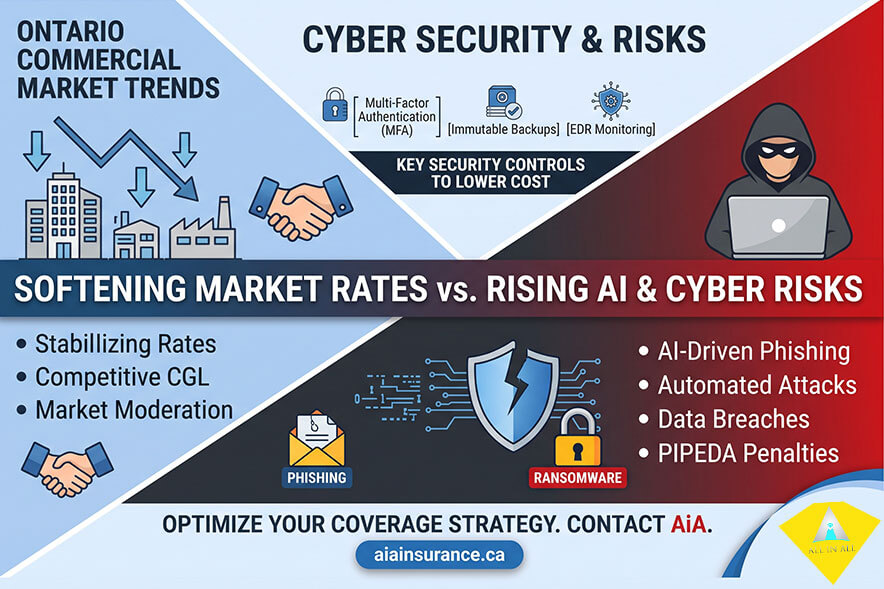
Understanding cyber insurance requirements is becoming essential for Ontario organizations. While premium rates for standard Commercial General Liability (CGL) are stabilizing across Canada, rising AI-driven phishing and ransomware force underwriters to demand strict security controls. Consequently, small-to-medium enterprises (SMEs) must update their risk strategy.
Standard liability policies protect physical storefronts and third-party injuries. Yet, standard coverage leaves digital assets exposed to online attacks.
Analyzing the Ontario Commercial Insurance Market Update
Commercial property rates are moderating. Thus, businesses can secure competitive baseline pricing. Savings achieved on CGL policies can fund digital risk protection.
AI tools allow cybercriminals to execute targeted email phishing schemes. Therefore, threat actors frequently target small businesses with automated vulnerability scanners.

Identifying Essential Small Business Cyber Insurance Requirements
Underwriters now require technical security verification before issuing policies. Maintaining affordable premiums depends on key controls:
-
Enforce Multi-Factor Authentication (MFA) across all networks.
-
Secure isolated, immutable data backups off-site.
-
Install AI-backed endpoint monitoring on all devices.
Action Plan: How to Lower Business Liability Insurance in Ontario
Meeting small business cyber insurance requirements involves treating cybersecurity posture as an underwriting asset. Demonstrating reduced risk helps brokers negotiate better terms with commercial carriers.
Licensed brokers evaluate coverage options across multiple commercial insurers. Therefore, brokers match specialized endorsements to your specific industry segment.
Connect with an experienced commercial advisor at AiA Insurance Brokers to complete a comprehensive business risk review